
Strengthen Your Manuscript Without Losing Your Voice
Professional structural editing to improve pacing, character development, clarity, and your manuscript works as a complete, compelling story.
Whether your draft needs sharper structure, stronger emotional arcs, or help resolving pacing issues in the middle, our developmental editors provide detailed, actionable feedback and a clear revision roadmap.
Most manuscripts don't fail because of writing quality. They struggle with structure, pacing, and narrative momentum. Developmental editing identifies those issues and shows you exactly how to fix them.
Get a Developmental Editing QuoteIs Developmental Editing Right for You?
This service is designed for writers who:
- Have a finished or near-finished draft
- Sense something isn't working, but can't identify what
- Are getting inconsistent or unclear feedback from beta readers
- Feel the middle of the book loses momentum, or that characters aren't landing emotionally
- Are preparing for submission, agents, or publication
- Want expert editorial feedback before copyediting
- Are ready to revise seriously and improve the manuscript
If that sounds like you, we help you refine structure, clarity, and narrative impact so your book performs at its best.



What Is Developmental Editing?
Developmental editing focuses on how your manuscript works as a whole, not sentence-level polish. We examine the structural and narrative foundations of your book to understand what's working, what's weakening impact, and what needs to change for a stronger reader experience.
This is big-picture editing that improves:
- Story structure and progression
- Pacing and momentum
- Character arcs and development
- Scene effectiveness
- Narrative clarity
- Point of view consistency
- Emotional engagement
- Thematic coherence
The goal is simple: a manuscript that reads as intentional, cohesive, and engaging from beginning to end.
What You Receive
You don't just receive feedback; you receive a clear revision direction.
- A structured breakdown of what's working and what isn't
- Clear revision priorities (what to fix first, and why)
- A practical roadmap for improving structure and pacing
- The editorial reasoning behind key recommendations
- Scene-level insights where relevant
- Guidance on strengthening reader engagement and narrative flow
The result is clarity, not just critique.

What Developmental Feedback Looks Like
Here's the kind of issue our developmental feedback identifies — and how we frame the direction to fix it:
Manuscript Moment
A character's key motivation is revealed midway through the novel. But earlier chapters have already established a different emotional expectation for the reader, creating a subtle disconnect that forces readers to reinterpret earlier scenes.


Editorial Direction
This motivation is important to the character's arc, but it would land harder if it were established earlier at the point where emotional tension begins to build. Introducing it sooner strengthens continuity and lets later scenes carry deeper meaning, rather than prompting readers to recalibrate after the fact.
Editor Insight
This is a structural timing issue, not a problem with the scene itself. The scene works on its own; it's the placement that affects how the reader interprets everything before it. When key motivations arrive too late, readers experience a shift in understanding that can weaken emotional continuity and pacing.
Developmental editing aligns structure so that character motivation unfolds at the right time, cause and effect feels natural across scenes, emotional continuity holds, and pacing supports the story rather than interrupting it.
The aim is not to change your story, but to refine how it unfolds.
Not sure what your manuscript needs next? Submit it to our team for expert assessment, and we’ll guide you towards the right editorial approach with a tailored recommendation and quotation. With our professional guidance, you can move forward with confidence, knowing your manuscript is in the right hands.
Request a Free Editorial AssessmentBefore and After
From Novella to Novel
Two real developmental edits, anonymised.
The draft that came to us.
A literary novel arrived as a short, novella-length manuscript. The voice and ideas were strong, but the story leaned almost entirely on the narrator's introspection — long reflective passages carried the meaning, while dramatised scenes, dialogue, and incident were sparse. Secondary characters were thinly drawn, & the pacing didn't pull the reader forward.
What the edit identified.
Rather than tidying sentences, the developmental edit focused on structure and momentum: rebalancing reflection against dynamic scenes, turning key introspective passages into dramatised action and dialogue, deepening characters through interaction and contrast, and grounding scenes with concrete detail of time, place, and role. The direction was delivered as a chapter-by-chapter roadmap the author could work from, then reviewed draft by draft.
What changed.
Working through the roadmap, the author rebuilt the manuscript — cutting and consolidating chapters, adding new scenes and dialogue, and weaving the reflective material into the drama instead of letting it sit apart from it. Tension and pace carried through. The book roughly doubled in length, growing from a novella into a full novel.
“The story is much more full than I expected it ever would be. It all feels more real now… we almost doubled the word count, and in the end this reads far more like a novel than the novella I started with. I really took it all with an open mind and a lot of trust, and I'm happy with the results.”
"Your tweaks made the mystery element pop out more. I didn't see that coming — it inspired a whole new scene."
A Buried Opening
A real developmental edit, anonymised.
The draft that came to us.
A genre novel blending family drama with classical mythology opened with a large block of backstory. It was so front-loaded that, several pages in, a reader still couldn't tell what kind of book it was or what its central story really was — the hook was buried under context.
What the edit identified.
The book needed to start closer to its real engine. The direction: bring the inciting events forward, let the central mystery surface early to pull the reader in, and release the backstory in smaller pieces later, where it would land with more weight instead of stalling the start.
What changed.
The author restructured the opening and held the large backstory block back for later chapters. With the mystery now up front, the momentum shifted — and the change sparked new material, including a sharper closing beat that raised the threat at the end of the first book.
Watch
What Book Editors Really Do
To understand how developmental editing fits into the wider editorial process, watch this short overview.
Not sure which level is right for your manuscript?
Get in touch & we’ll recommend the most appropriate approach and provide a tailored quotation.
Get in touchGet in touch & we’ll recommend the most appropriate approach and provide a tailored quotation.
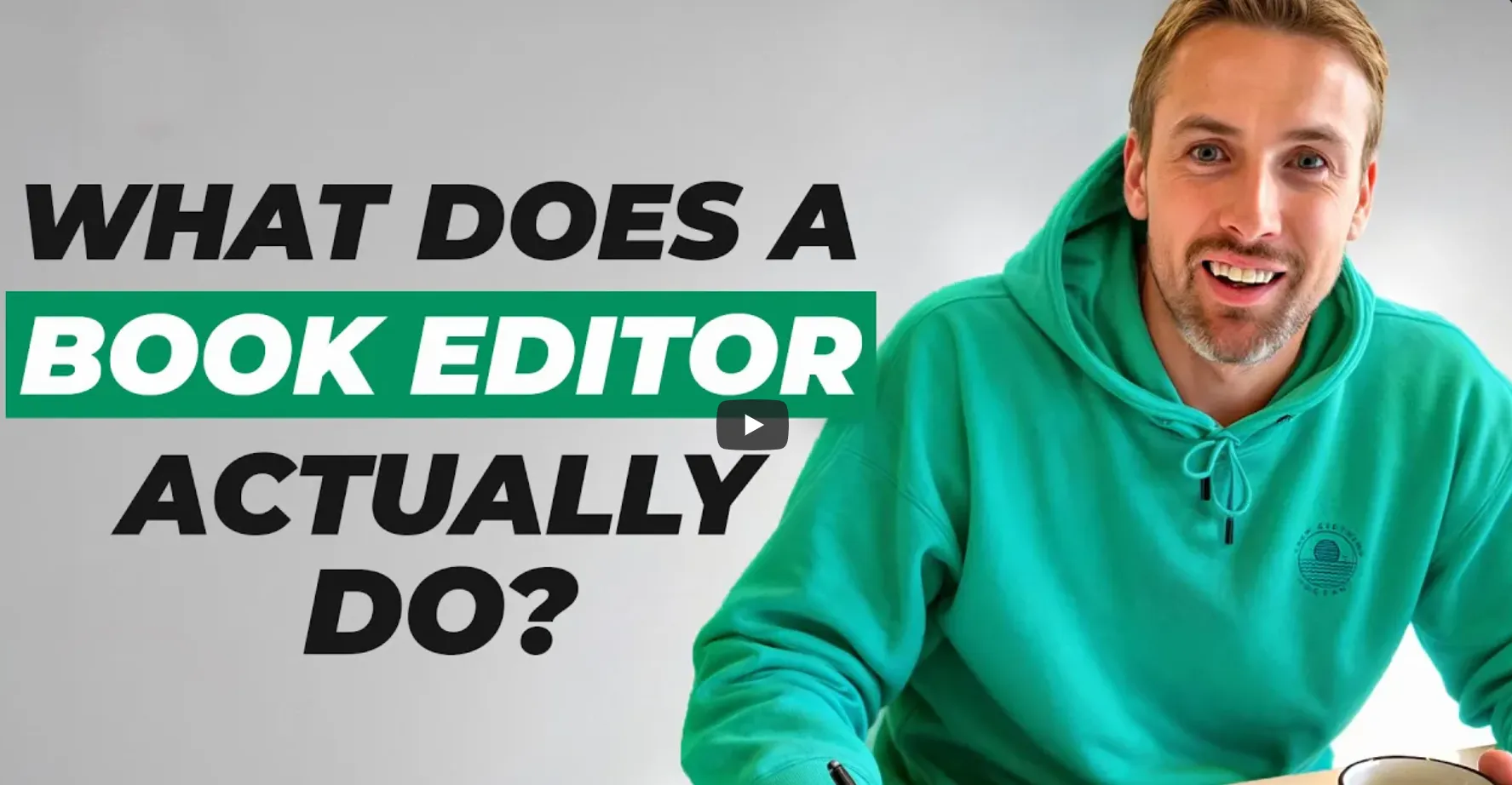
What Book Editors Really Do (And Why Your Manuscript Needs One)
Why Authors Work With Us
Our developmental editors are carefully selected, highly experienced professionals with backgrounds across traditional and independent publishing. We take the time to vet our editors to ensure they bring the expertise, insight and attention to detail needed to help authors strengthen their manuscripts.
Our editorial rates are benchmarked against the Chartered Institute of Editing and Proofreading (CIEP) guidelines, reflecting our commitment to paying skilled human editors fairly and maintaining the quality of work our authors deserve.
Our role is never to impose a particular writing style, but to understand what you're trying to achieve and provide thoughtful, practical guidance that strengthens your storytelling, structure and reader engagement.
“The story is much more full than I expected. Everything feels more real now. We almost doubled the word count, and the result reads far more like a complete novel than the novella I started with.”
“The developmental edit helped me see my book as a whole. I finally understood where the pacing slowed, which scenes needed more attention, and how to strengthen the plot. Having a clear plan made the revision process far less overwhelming.”
“What I appreciated most was that the feedback explained not just what wasn't working, but why and how to improve it. I gained a much better understanding of my writing, along with practical advice I'll carry into every book I write.”
“The feedback helped me understand my characters' motivations, strengthen their relationships, and make their emotional journeys more convincing. It gave me a clearer direction and helped bring more emotion and authenticity into my story.”
“I wanted honest feedback without losing my unique writing style. The editorial guidance struck that balance beautifully, challenging me where needed while respecting my vision. I felt encouraged to make stronger choices without changing the heart of my book.”
“The developmental edit gave me an honest assessment of my manuscript and a practical path to improving it. The suggestions helped me understand what needed to change and why. I now have a clearer vision for my book and feel more confident taking the next steps.”
Do You Need a Genre-Specific Editor?
Genre experience helps with conventions and expectations, but developmental editing is primarily about story structure and reader experience. Our editors focus on structure and pacing, character development, emotional engagement, narrative clarity, and reader momentum — principles that apply across literary and commercial fiction, fantasy, science fiction, historical fiction, romance, thriller, memoir, and narrative non-fiction.

How to Get Started
- Send your manuscript details and word count
- We assess scope and recommend the appropriate tier
- You receive a clear proposal and timeline
- Your manuscript is scheduled for editorial review
Communication & workflow: Every author has a dedicated project manager who oversees the process and acts as their main point of contact. We follow a structured, transparent workflow while remaining flexible about how you prefer to communicate. Slack is our standard channel for day-to-day communication, with email available as an alternative. Internal tracking keeps everything organised and consistent across editors, feedback, and revision stages.
Not sure what editorial support your manuscript needs? Get in touch and we'll assess your project, recommend the most appropriate approach and provide a tailored quotation.
Get in touchWant to know more?
Get in touch!


Thank you! Your submission has been received!
Oops! Something went wrong while submitting the form.


HQ: Publishing Push LTD, Second Floor, 3 Liverpool Gardens, Worthing, England, BN11 1TF


